Monday, April 04, 2005

DETECTIVE COMICS #571 DC Comics 1987


He’s back! The pharaoh of phobias! The duke of dread! The Scarecrow.

An issue from writer Mike Barr and artist Alan Davis’ run on Detective Comics. The Barr/Davis issues were fun retro romps through Giant Typewriter Land instead of grim slogs through Crime Alley. These issues feature the almost universally hated Jason Todd version of Robin, but I like them anyway – they’re just old school Batman & Robin stories told with style. I’m a huge fan of Alan Davis, who worked on this run with inker Paul Neary. Davis is one of the best artists working in comics today – his work is so clean and confident – I just think he’s the shit. I mean that in a good way.

Much like the Silver Age comics they pay tribute to, this brief run of Detective Comics features stories that wrap up in one comic book and don't stretch out over multiple issues. This issue is a tightly plotted and drawn comic book that efficiently tell the story, then gets the hell out. Sure, it's a little cheesy, but intentionally so. I love it.

Extra points for multiple death traps and bullfighting with semi trucks.

Sunday, April 03, 2005

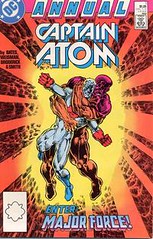
CAPTAIN ATOM ANNUAL #1 DC Comics 1988


Captain Atom was one of the Charlton Comics characters that DC bought the rights to, along with Blue Beetle, Nightshade, and Judo Master. Now why haven’t they made a Judo Master comic? I’d buy that. Anyway, Captain Atom first appeared in Space Adventures #33 in 1960, published by Charlton Comics, a smaller comic company that went out of business in the 70’s. DC bought all the Charlton characters, apparently as cannon fodder for "event" comics. I can just see those sinister DC Editors in their Star Chamber, talking about the latest crossover marketing scheme: "We're gonna call it The Crisis Gauntlet and to kick the whole thing off, we're gonna kill Judo Master."

I digress. Let's talk about Captain Atom. The character’s first modern appearance was in Captain Atom #1 in 1987, drawn competently by Pat Broderick. In the sixties, Air Force Captain Nathaniel Adam (get it? Captain Adam!!!) was tried and convicted of treason, despite his protests that he had been framed. The sentence for his supposed crime was death, but the Air Force offered Adam a full pardon if he would take part in a top secret research project. For the project, Adam had to allow himself to be wrapped up in a cocoon composed of an alien alloy captured from a crash-landed spacecraft. The entire cocoon was then placed on top of a Hydrogen bomb, which was promptly detonated. The alloy fused with him and he became the “quantum-powered” Captain Atom. A human nuclear reactor, he could fly, shoot quantum blasts, absorb tremendous amounts of energy, etc.

I’m spending entirely too much time talking about Captain Atom. The comic book was okay – he fought villains like the psycho Major Force and the explosive babe Plastique, who was a Quebec separatist terrorist. No shit. It lasted 57 issues, and he also appeared on and off in Justice League comics and in lame cancelled comics like Extreme Justice. The character was never very popular for one simple reason... Captain Atom is a tool. Whenever writers need an asshole superhero, they get Captain Atom. He’s constantly trying to beat up other heroes on behalf of the federal government. Whenever heroes get in trouble with the government or the military, they always have to fight Captain Atom. He’s an arrogant right-wing imperialist war-mongering asshole. I know, that’s a mean thing to say about a comic book character, but it’s true.

Let's talk about this issue, the Annual. I'm going to be blunt: On the cover it looks like Captain Atom is getting rogered* by Major Force. It does, look. "Enter: Major Force” indeed.

This is one of the rare comic book annuals that was actually produced by the book’s regular creative team. The tradition of double sized annual issues began with DC in the 60’s – they were usually put out in the summer months and promised extra story! Extra excitement! In reality, many annuals featured reprint material or were created by a different creative team. The stories were usually sub-standard inventory stories that had no effect on the ‘regular” storyline. Marvel had a tradition in the 90’s of having a crossover storyline running through all their annuals – you know, a mutant life form fights Daredevil in his annual, then grows bigger and fights Spider-Man in his annual, then grows bigger and fights Thor, etc. Generally speaking, annuals suck.

This annual sucks, too, but not for the usual reason. It sucks because the story, by Cary Bates, sucks. Specifically the dialogue. Regular Captain Atom artist Pat Broderick supplied his usual decent work, but man, the dialogue!

“My pal the Captain needs help – and I’m just the major who’s gonna give it to him!”

As usual, Captain Atom is a pawn of The Man in this issue and is generally just a tool. The psychotic villain Major Force is introduced – he goes on to kill Green Lantern’s girlfriend and stuff her corpse in a fridge, although some say Ron Marz did it.

Again, just to reiterate -- Captain Atom is a tool.

*By "rogered" I mean "fucked up the ass."

Saturday, April 02, 2005

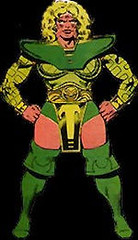
Lame-ass villain #2: Anaconda


What's wrong with Anaconda?

First of all, she's a woman and her name is Anaconda. Second, her powers: her arms stretch out into these big constricting snake-like appendages. I don't know, the whole thing is very Freudian and weird. Penis envy much, Anaconda?

Anaconda was/is a member of the Serpent Society, who on the Villain Threat Scale are right above Power Pack and right below the Salem Seven. Sad.

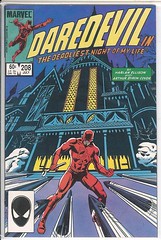
DAREDEVIL #208 Marvel Comics 1984


“The Deadliest Night of My Life.”

Esteemed science fiction writer Harlan Ellison wrote this kick-ass Daredevil issue. Ellison is known by most geeks as the writer of the classic Star Trek episode “City on the Edge of Forever” – the one where Joan Collins gets hit by a truck. Artist David Mazzuchelli was the regular DD artist at the time. He would go on to work with Frank "The Tank" Miller* on Batman: Year One and in the "Born Again" arc in Daredevil. I fucking love Mazzuchelli.

This is a great example of Western comics' compressed narrative storytelling. A lot goes on in this single issue. I can imagine that Ellison’s script was packed with story and was a nightmareto illustrate, but Mazzuchelli is clearly up to the task, and this issue is a very satisfying read. Who doesn't love death traps? In short, Daredevil gets lured into a gigantic mansion by creepy exploding little girl robots, only to find that the mansion is a deathtrap with one purpose only: kill Daredevil!!!! Our hero has to run a gauntlet of lethal traps (spikes, poison gas, spikes, sharks, spikes, fire) before he finds out who the mastermind is.

This is one of my favorite issues of Daredevil and is one of the comics that I continually re-read as a kid. It's up there with G.I. Joe "Silent Interlude" and the Sienkiewicz "Demon Bear" story in New Mutants. In an era of de-compressed storytelling, where some writers will streetch out storylines and/or spend valuable page real estate on padding (what kid wants to read pages of Mary Jane auditioning for a part?), this Daredevil comic stands as an exemplar of the virtues of packing as much super-hero goodness in a book as possible.

*Nobody has actually ever called Frank Miller this. I'm trying to start a new nickname for him.

Friday, April 01, 2005

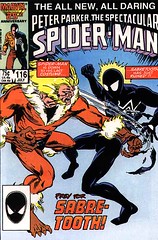
PETER PARKER, THE SPECTACULAR SPIDER-MAN #116 Marvel Comics, 1986


Here’s a story from the “black costume” era, when the editors thought Spider-Man’s traditional costume wasn’t cool enough.

Stupid editors.

I liked the black costume okay, but it just didn’t feel like Spider-Man to me. How did he get the black costume? I'm glad you asked. During the Secret Wars crossover, Spider-Man gets this inky black alien symbiote costume that is like an oil slick that responds to his mental commands. When he comes back from the Secret Wars, he keeps the costume. The thing goes crazy and tries to possess or kill him or something, so he gets rid of it. Spider-Man thinks the design is fabulous so he makes some replica costumes with the same design. Meanwhile, the alien costume grafts on to a psychotic felon named Eddie Brock, and the super-villain Venom is created to bore a new generation of Spidey fans.

I’m getting a little ahead of myself. This issue guest-stars The Black Cat, Spidey’s hot ex-girlfriend, who gets beat up by a bunch of “thugs” with Mohawks and headbands. I'm sure this scene served as grist for more than one masturbatory adolescent power fantasy. Anyway, guys like these thugs only appear in comic books and Jackie Chan movies. “Those bikers look tough! They use colored hair spray, listen to ‘rock’ and ride ATVs!”

Writer Peter David had a good run on Spectacular Spider-Man before moving on to The Incredible Hulk. His Spider-Man comics were a nice mix of light-hearted adventure and crime drama – a psycho named the Sin-Eater killed a major supporting character. Peter David is fond of puns and wisecracks (Some might say overly so: Remember "A brush with Death?" in the Hulk?), and so is Spider-Man, so the two were a good match.

Bad guys for this issue are The Foreigner, a Peter David villain who I always kind of liked because he was such a droll wise-ass, and Wolverine’s nemesis Sabretooth, who really goes out like a chump in this issue. Spider-Man shoots Sabretooth in the face with webfluid, covering his face with webbing. Sabretooth freaks out like a little girl and tears the webbing off - with his claws! He screams something like "AAAGH! MY FAAAACE!!!!" instead of "AAAGH! My healing factor!"

Thursday, March 31, 2005

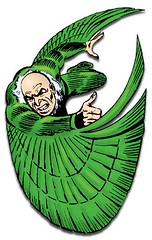
Lame villain #1: The Vulture


Heads up, true believers! Flyin' old guy, coming through!

The Vulture is one of those villains that is so hopelessly outclassed by the hero that you wonder why they bother. The Vulture's powers are flight and baldness - that's it. I'll bet Spider-Man is psyched every time he gets to fight The Vulture; he can just kick the guy's ass and call it an early night, maybe go watch some TV or something.

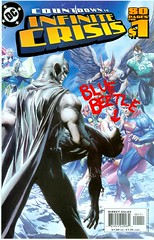
COUNTDOWN TO INFINITE CRISIS DC Comics, 2005


In a nutshell: Blue Beetle dies and Max Lord is the bad guy.

SPOILER ALERT!

Hmm, maybe in the future I should place the spoiler alert in front of the actual spoiler. Something to remember for next time.

Okay, let’s start off the blog with a review of a recent comic book. I know, you were probably hoping for a review of Spectacular Spider-Man #116 or something, and I pull this contemporary shit on you. Sorry. But hey, if I bought it, it’s part of my collection, and thus eligible for review and or/mockery.

Countdown is a comic book loss-leader, an 80-page comic that costs a buck. It’s the opening salvo in this summer’s Crossover Wars, and the prelude to a metric assload of crossovers that DC has on tap. (Look, I used a triple-mixed metaphor.) Designed to entice the reader into purchasing the Infinite Crisis books that will follow, Countdown functions as an overview of the current post-Identity Crisis DC Universe, as well as a teaser for a mega-storyline featuring a suddenly evil Max Lord, Checkmate, a new version of O.M.A.C., and a sulking Batman.

A doomed Blue Beetle serves as sort of our tour-guide through the DCU as he draws closer to uncovering the plans of a shadowy government agency, whose xenophobic leader wants to eradicate superhumans with the help of some dangerous advanced technology. I was half expecting a bunch of Sentinels to show up. As I cruelly already mentioned, the mastermind of this DC version of Project: Wideawake is none other than Maxwell Lord, former financier of the Justice League. Previously Max has been portrayed as a smooth-talking, ethically challenged grifter who, deep down, is an okay guy. Here he shoots Blue Beetle in the head. I guess that’s what you call character arc.

Don’t get me wrong, I actually kind of like Countdown. It was only a buck, for God’s sakes. How can I complain? I always kind of liked Blue Beetle, but how bent out of shape should I get because they killed him off? It’s not like when they KILLED HAWKEYE FOR NO GOOD REASON!!! DAMN YOU BENNNDIIIS!!! Anyway, I can handle him getting killed, though it does perpetuate this disturbing trend of killing off characters in “event” comics. Like Hawkeye. Bendisss…

There is one really funny bit in the book: Beetle calls in a bunch of heroes to help him investigate a break-in at one of his company’s warehouses. Don’t get me wrong, I can see why you’d want Nightwing or Cyborg or Dr. Fate to look for clues, but what are all these other people doing there? It’s a hilariously contrived way of jamming as many heroes into the book as possible. What is Green Arrow going to do, fire a microscope arrow? There’s a great panel of all the heroes at the crime scene just sort of standing around contaminating any evidence that might be there. Power Girl is looking in a dumpster for God’s sake. Do you really need to call in Power Girl to check what’s inside the dumpster?

Countdown to Infinite Crisis gets extra points from me for including this line:

“It’s war with Thanagar!”

Introduction

The costumed superhero, like jazz, is a uniquely American contribution to the global culture. Superman, the father of superheroes, is an enduring and iconic figure around the world – except for those poor brainwashed bastards in North Korea.

This blog modestly attempts to provide the reader with an overview of the American superhero comic, using examples culled from my vast but myopic comic book collection. Is this an exhaustive work? No. Is it exhausting? Certainly. A scholar of comics history would laugh at the glaring omissions in this volume. No Shazam? What about Will Eisner’s seminal comic The Spirit? I would then punch the scholar of comics history in his fat belly. As I said, the examples used in this work come from my own collection, and as I don’t have a $400 copy of Tales To Astonish #1 or a number of other important works, there will be some big holes. Sue me.

Here’s how it works: I pull comics from my collection and comment on them. Each commentary may have some sort of information about the comic, its creators, or why I like it or hate it. I will often swear or make derogatory comments about the comic examples. I'm assuming the reader knows very little about the subject at hand, so don't get offended if my overview of say, Iron Man seems simplistic and patronizing. Please note that the examples given are NOT the best American superhero comics, they exist only to give the reader a greater understanding of the subject. There are a few truly awful comics in here.

I hope that you enjoy your foray with me into the world of American superhero comics. And please take care of the comics -- I want them back. They may suck, they may be goofy, they may be offensive, but they’re comics and I love them. I hope you will too.

Say no more!


-David Campbell